The Treatment That Doesn't Exist
When you want to feel better, but every treatment seems to be a problem.
Sometimes an appointment takes an interesting turn.
A patient comes in with a long list of complaints. Pain in several joints, stiffness, fatigue, poor sleep, difficulty walking, working, exercising, or simply getting through the day. There may be a thick folder of medical records and a long history of treatments that supposedly did nothing.
The symptoms have taken over much of this person's life. They are frustrated, exhausted, and understandably want something to change.
We spend time going through the history, examining the joints, reviewing test results, and sorting out what might be causing the symptoms. Sometimes the diagnosis is clear. Sometimes we still have questions.
Eventually, we get to the practical part: what can we actually do about it?
And this is where things become complicated.
A short course of corticosteroids, perhaps five days?
"Oh, no. I don't take hormones."
An anti-inflammatory medication?
"Those things destroy your stomach and kidneys."
We discuss the actual risks, whether they apply to this particular patient, and what precautions might be needed.
Still no.
Another medication?
"Isn't that all chemicals?"
Well, yes. Like everything else, including the water we drink. But I have learned that a chemistry lesson rarely helps at this particular moment.
How about a medication taken once a week?
"I tried something like that. It made me nauseated."
For how long?
"About fifteen minutes. But I'm not going through that again."
We discuss whether the nausea could be prevented, whether a different formulation might help, or whether another medication would be more suitable.
No interest.
There is another option, but the copayment might be ten dollars higher.
"Ten dollars? Absolutely not."
An alternative treatment schedule?
Too inconvenient.
A treatment that takes several weeks to show its full benefit?
Too slow.
A medication that controls the disease but doesn't permanently cure it?
"Then what's the point? I don't want to take medication for the rest of my life."
At some point, I ask what the patient would consider acceptable.
The answer, in various forms, is usually something along these lines:
"I just want something that works. Right away. I want this gone, not just controlled. And I don't want side effects."
Preferably one pill, taken once, with no monitoring, no inconvenience, no additional expense, and no chance that the symptoms will ever return.
I would love to have that medication.
So would every other physician.
Unfortunately, nobody has invented it.
This is not a transcript of one particular appointment. It is a composite of a conversation that many physicians will recognize, with the objections collected into one imaginary visit.

Main lettering in the illustration
Patient: “So… this is what I’m looking for!”
Requirements for the Perfect Treatment: works immediately; cures forever; no side effects; free; one pill; no monitoring; no inconvenience.
“Is that too much to ask?”
Physician’s thought: “Ambitious. I like it.”
And before anyone objects to the objections, there is something important to say.
Saying no is not the problem
I take medication concerns seriously. Corticosteroids have real risks, including during short courses. Anti-inflammatory drugs can cause gastrointestinal bleeding, kidney problems, and cardiovascular complications. Some medications genuinely make people miserable.
If someone tells me a drug caused nausea, I don't need to argue that fifteen minutes is a short time. Fifteen minutes of feeling sick is still fifteen minutes of feeling sick.
And ten dollars is not necessarily a trivial amount. For some patients, the cost of treatment is a very real obstacle.
There are also perfectly good reasons to reject a medication because of other health conditions, previous complications, pregnancy plans, or simply because the expected benefit does not justify the burden.
Patients should ask questions. They should understand what they are taking and why. They should be able to say no.
I can work with all of that.
What becomes difficult is something different: when we address one concern, find an alternative, and immediately encounter a new objection. Then another. And another.
The issue is no longer a particular medication or side effect. Almost any proposed treatment becomes unacceptable for one reason or another.
Yet the expectation remains exactly the same: Doctor, fix this.
Now.
And preferably forever.
What is the doctor supposed to do?
There are limits to what medicine can offer.
Many rheumatic diseases are chronic. We can often control inflammation, prevent damage, improve function, and help people lead much better lives. Sometimes remission is possible, and sometimes treatment can eventually be reduced or discontinued.
But we cannot promise a permanent cure for every disease.
We also cannot guarantee that a medication will work for a particular person, or that it will work immediately. We can discuss probabilities, expected benefits, risks, alternatives, and what we will do if the first choice fails.
That is a realistic medical conversation.
Sometimes we have to choose between a faster effect and a less favorable safety profile. Sometimes effective treatment requires blood tests. Sometimes a medication needs several weeks or months before we can properly judge the result.
And sometimes the best decision is not to prescribe anything new, particularly when symptoms are not being driven by active inflammation. More medication is not automatically better medicine.
There is also a difference between a treatment being imperfect and a treatment being unacceptable.
If every medication must be completely risk-free, every schedule perfectly convenient, every cost negligible, and every result immediate and permanent, there may be nothing left to offer.
Not because the doctor has run out of ideas.
Because the conditions attached to accepting treatment have become impossible to meet.
I occasionally wonder what people imagine happens after the sixth or seventh alternative is rejected. Do they think we have a secret drawer of wonderful medications that we have somehow forgotten to mention? One that contains all the effective drugs without any of the disadvantages?
If such a drawer existed, we would have opened it first.
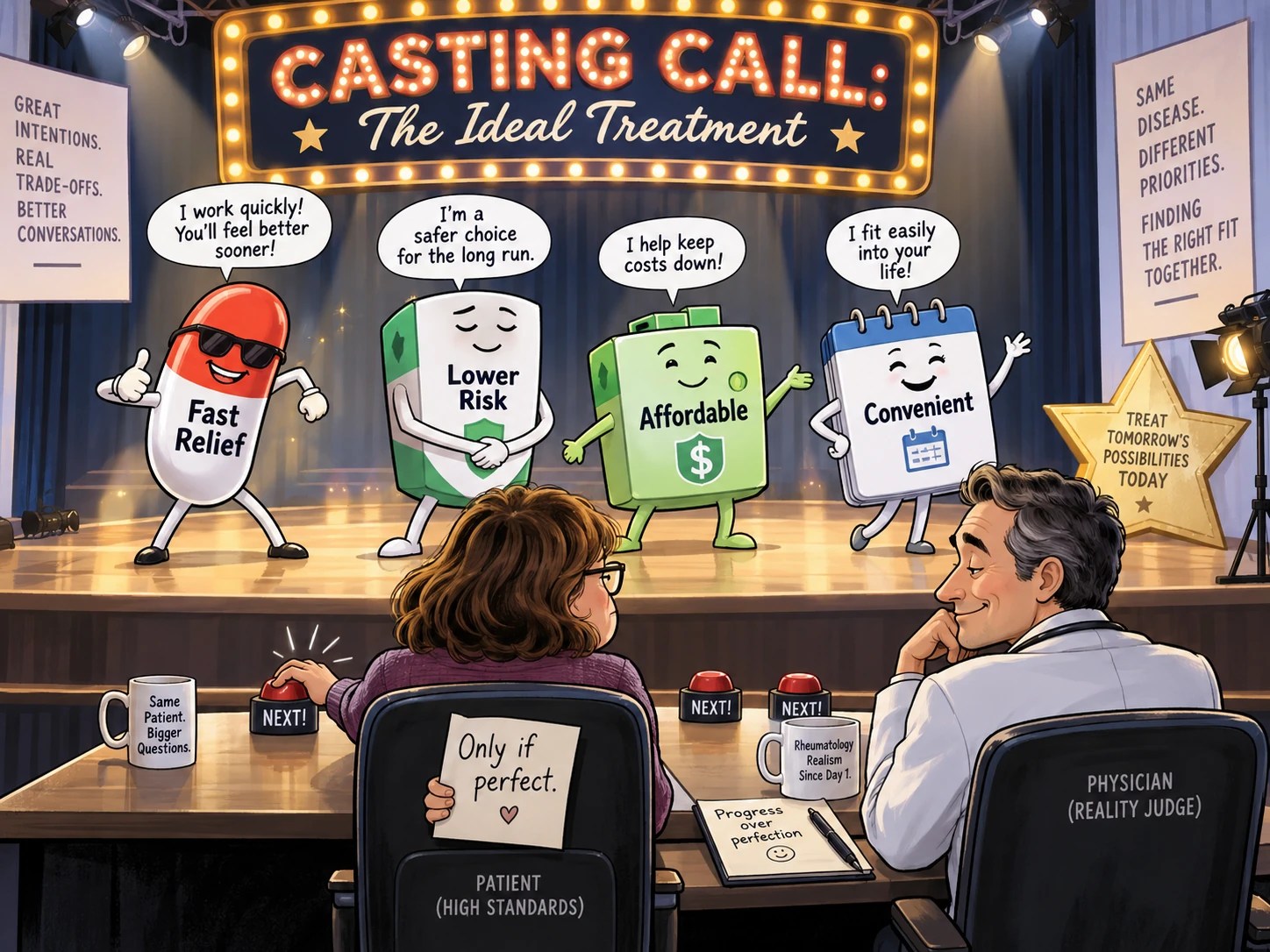
Main lettering in the illustration
Casting Call: The Ideal Treatment.
Fast Relief: “I work quickly! You’ll feel better sooner!”
Lower Risk: “I’m a safer choice for the long run.”
Affordable: “I help keep costs down!”
Convenient: “I fit easily into your life!”
Patient: “NEXT!” The hidden scorecard: “Only if perfect.”
The chairs: “Patient (High Standards)” and “Physician (Reality Judge).”
There is another side to this conversation
I don't think everyone who behaves this way is simply being unreasonable.
Sometimes a person has had a frightening experience with medication. Sometimes they are overwhelmed by years of illness. Sometimes they have been promised too much by previous treatments, advertising, or stories from other patients.
And sometimes, after living with pain for so long, they are simply tired of hearing about compromises.
I understand that.
But understanding why someone wants an impossible solution doesn't make the solution possible.
There is a point at which continuing to suggest medications becomes less useful than stopping to discuss what the patient is actually prepared to accept.
I might say something like this:
"We have several options, and none is perfect. We can work on reducing the risks, finding something affordable, changing the schedule, or choosing a different approach. But I need to understand what matters most to you and which compromises you can live with."
Occasionally, that changes the conversation.
The patient may finally say that the real concern is losing the ability to work, becoming dependent on medication, or repeating an experience that was genuinely frightening.
Now we have something specific to address.
Other times, the answer is still no to everything.
That is also a decision, even if the patient doesn't think of it that way.

Main lettering in the illustration
Patient: “No, no, no, no, and no!”
The cloud: “One free pill, no side effects, works forever.”
The real paths: short steroid course; NSAID; weekly medication; physical therapy; watchful waiting.
Physician’s thought: “Sigh… I wish it were that easy.”
The map: “Real progress still counts.”
Doing nothing isn't always neutral
There are situations in which observation, physical therapy, exercise, lifestyle adjustments, or symptom management without medication are perfectly reasonable choices.
There are also diseases in which delaying effective treatment can lead to permanent joint damage, organ complications, or other consequences that might have been prevented.
It depends on the diagnosis and the individual circumstances.
Refusing a medication doesn't mean a person deserves those consequences. Of course not.
But refusing treatment does not make the underlying disease disappear, either.
My responsibility as a physician is to explain what I believe is happening, what the reasonable options are, what each can and cannot accomplish, and what the risks of waiting might be. If a treatment is not appropriate, I should say so. If there are alternatives, we should discuss them.
I cannot make someone take a medication, nor would I want to.
But I also cannot manufacture an eighth option that somehow has none of the limitations of the previous seven.
At some point, the conversation needs to move beyond "I don't want that" to "Here is what I would be willing to try."
Or even, "I understand the risks, but I'm not ready to start treatment."
That is an honest answer. We can document it, discuss a safe follow-up plan, and revisit the decision when appropriate.
What we cannot do is keep searching indefinitely for something that does not exist.
The treatment nobody can prescribe
A good physician should listen, explain, adapt, and take a patient's circumstances seriously. There is usually more than one way to approach a problem, and sometimes finding the right approach takes patience from both sides.
But no amount of medical knowledge can eliminate every uncertainty, inconvenience, expense, or possible adverse effect.

Main lettering in the illustration
The Perfect Pill.
The four promises: instant; permanent; risk-free; free of charge.
The pedestal: “Some things are still a work in progress.”
The glass display case is empty.
You don't have to agree to every treatment a doctor suggests. You don't have to accept a medication that you believe is wrong for you. And you certainly shouldn't be embarrassed to raise concerns.
Just remember that medicine involves choices between real options, not between a real option and an imaginary perfect one.
If you reject a treatment, tell your doctor why. If the alternative is also unacceptable, explain what would make it workable. If nothing feels acceptable right now, say that.
We may still be able to find a way forward.
And if we cannot, at least we can be honest about where things stand.
You came to the appointment because something needs to change.
Sometimes the next step is a new medication.
Sometimes it is a different plan.
And sometimes it is recognizing that waiting for a treatment with no disadvantages may mean waiting while the illness continues.
The perfect pill isn't coming. That doesn't mean there is nothing worth trying.
Иногда приём принимает любопытный оборот.
Пациент приходит с длинным списком жалоб. Боли в нескольких суставах, скованность, усталость, плохой сон. Трудно ходить, работать, заниматься физкультурой, а порой — просто прожить обычный день. В руках может быть толстая папка медицинских документов, а за плечами — долгая история лечения, которое, по словам пациента, совершенно не помогло.
Симптомы подчинили себе большую часть его жизни. Человек измучен, раздражён и, вполне понятно, хочет, чтобы наконец что-то изменилось.
Мы подробно разбираем историю болезни, осматриваем суставы, просматриваем результаты исследований, выясняем, с чем могут быть связаны жалобы. Иногда диагноз ясен. Иногда вопросы ещё остаются.
Наконец доходим до практической части: что мы можем с этим сделать?
Вот тут и начинается самое интересное.
Короткий курс кортикостероидов, допустим, на пять дней?
«Ой, нет. Гормоны я не принимаю».
Противовоспалительный препарат?
«Они же убивают желудок и почки».
Обсуждаем реальные риски, насколько они значимы именно для этого пациента и какие меры предосторожности могут понадобиться.
Всё равно нет.
Другой препарат?
«Это же сплошная химия?»
Вообще-то да. Как и всё остальное, включая воду, которую мы пьём. Но я уже научилась: урок химии в этот момент обычно мало помогает.
А лекарство, которое принимают раз в неделю?
«Я пробовал что-то такое. Меня от него тошнило».
Как долго?
«Минут пятнадцать. Но больше я на это не согласен».
Обсуждаем, можно ли предотвратить тошноту, поможет ли другая форма выпуска или лучше подобрать другой препарат.
Интереса нет.
Есть ещё один вариант, но доплата по страховке может оказаться на десять долларов больше.
«На десять долларов? Нет, ни за что».
Другая схема лечения?
Слишком неудобно.
Лечение, полный эффект которого проявится через несколько недель?
Слишком долго.
Лекарство, которое позволяет контролировать болезнь, но не избавляет от неё навсегда?
«Тогда какой смысл? Я не хочу всю жизнь сидеть на лекарствах».
В какой-то момент я спрашиваю, какой вариант пациент счёл бы приемлемым.
Ответ, в разных формулировках, обычно сводится к следующему:
«Мне просто нужно что-нибудь, чтобы помогло. Сразу. Чтобы всё прошло, а не просто было под контролем. И без побочных эффектов».
Желательно одна таблетка. Один раз. Без анализов, неудобств, дополнительных расходов и малейшего шанса, что симптомы когда-нибудь вернутся.
Я бы очень хотела иметь такое лекарство.
Как и любой другой врач.
К сожалению, его ещё никто не изобрёл.
Это не стенограмма конкретного приёма. Это собирательная история: возражения из разговоров, знакомых многим врачам, сведены в один воображаемый визит.
Основные надписи: перевод
Пациентка: «Вот… именно это мне и нужно!»
Требования к идеальному лечению: действует сразу; вылечивает навсегда; без побочных эффектов; бесплатно; одна таблетка; без анализов и наблюдения; без неудобств.
«Разве я слишком многого прошу?»
Мысль врача: «Амбициозно. Мне нравится».
Но прежде чем кто-нибудь начнёт возражать против этих возражений, нужно сказать кое-что важное.
Проблема не в слове «нет»
Я серьёзно отношусь к опасениям по поводу лекарств. У кортикостероидов есть реальные риски, в том числе при коротких курсах. Противовоспалительные препараты могут вызывать желудочно-кишечные кровотечения, нарушения работы почек и сердечно-сосудистые осложнения. От некоторых лекарств людям действительно очень плохо.
Если человек говорит, что его тошнило, мне незачем доказывать, что пятнадцать минут — это недолго. Пятнадцать минут тошноты остаются пятнадцатью минутами тошноты.
И десять долларов — не обязательно пустяк. Для некоторых пациентов стоимость лечения действительно становится препятствием.
Есть и вполне веские причины отказаться от препарата из-за других заболеваний, перенесённых осложнений, планов на беременность или просто потому, что ожидаемая польза не оправдывает связанных с лечением трудностей.
Пациенты должны задавать вопросы. Они должны понимать, что принимают и зачем. И у них должна быть возможность сказать «нет».
Всё это можно учесть.
Трудности начинаются в другой ситуации: мы разбираемся с одним опасением, находим альтернативу — и тут же слышим новое возражение. Затем ещё одно. И ещё.
Дело уже не в конкретном лекарстве или побочном эффекте. Практически любое предложенное лечение по какой-нибудь причине оказывается неприемлемым.
А ожидание остаётся прежним: доктор, избавьте меня от этого.
Сейчас.
И желательно навсегда.
А что, собственно, должен сделать врач?
У возможностей медицины есть пределы.
Многие ревматические заболевания хронические. Нам часто удаётся контролировать воспаление, предотвращать повреждения, улучшать функцию и помогать людям жить значительно лучше. Иногда возможна ремиссия, а иногда со временем удаётся уменьшить объём лечения или отменить его.
Но обещать окончательное излечение от любой болезни мы не можем.
Мы также не можем гарантировать, что конкретное лекарство поможет конкретному человеку или подействует немедленно. Мы можем обсудить вероятность успеха, ожидаемую пользу, риски, альтернативы и то, что будем делать, если первый вариант не сработает.
Это и есть разговор о реальных возможностях лечения.
Иногда приходится выбирать между более быстрым эффектом и менее благоприятным профилем безопасности. Иногда эффективное лечение требует контроля анализов крови. Иногда лекарству нужно несколько недель или месяцев, прежде чем можно будет как следует оценить результат.
А иногда лучшее решение — вообще не назначать ничего нового, особенно если симптомы не связаны с активным воспалением. Больше лекарств не значит лучшее лечение.
И есть разница между несовершенным лечением и неприемлемым.
Если каждое лекарство должно быть абсолютно безопасным, каждая схема — идеально удобной, расходы — ничтожными, а результат — немедленным и окончательным, предлагать в итоге может оказаться нечего.
Не потому, что у врача закончились идеи.
А потому, что условия, на которых пациент согласен лечиться, стало невозможно выполнить.
Иногда мне любопытно, что, по представлению человека, должно произойти после отказа от шестого или седьмого варианта. Он думает, что у нас есть тайный ящик с чудесными лекарствами, о которых мы почему-то забыли упомянуть? И что там лежат все эффективные препараты, только без единого недостатка?
Будь у нас такой ящик, мы бы открыли его первым.
Основные надписи: перевод
Кастинг: идеальное лечение.
Быстрое облегчение: «Я действую быстро! Вам скорее станет легче!»
Меньший риск: «Я более безопасный вариант для длительного лечения».
Доступная цена: «Я помогаю снизить расходы!»
Удобство: «Я легко впишусь в вашу жизнь!»
Пациентка: «Следующий!» Спрятанная табличка: «Только идеальное».
Надписи на креслах: «Пациент (высокие требования)» и «Врач (судья от реальности)».
У этого разговора есть и другая сторона
Я не считаю, что каждый человек, который ведёт себя так, просто капризничает.
Иногда за этим стоит пугающий опыт приёма лекарств. Иногда человек подавлен годами болезни. Иногда предыдущие обещания, реклама или рассказы других пациентов сформировали слишком большие ожидания от лечения.
А иногда, прожив с болью столько лет, он просто устал слушать о компромиссах.
Я это понимаю.
Но понимание того, почему человек хочет невозможного, не делает невозможное возможным.
Наступает момент, когда полезнее перестать перечислять препараты и обсудить, на что пациент действительно готов согласиться.
Я могу сказать примерно так:
«У нас есть несколько вариантов, и ни один не идеален. Мы можем постараться уменьшить риски, подобрать что-то доступное по цене, изменить схему или выбрать другой подход. Но мне нужно понять, что для вас важнее всего и какие компромиссы для вас допустимы».
Иногда после этого разговор меняется.
Пациент наконец говорит, что на самом деле боится потерять возможность работать, оказаться зависимым от лекарства или снова пережить то, что когда-то его по-настоящему напугало.
Вот теперь у нас есть конкретный вопрос, с которым можно работать.
В других случаях ответ на всё по-прежнему «нет».
Это тоже решение, даже если сам пациент не воспринимает его как решение.
Основные надписи: перевод
Пациентка: «Нет, нет, нет, нет и нет!»
В облаке: «Одна бесплатная таблетка, без побочных эффектов, действует вечно».
Реальные пути: короткий курс стероидов; НПВП; лекарство раз в неделю; физическая реабилитация; наблюдение без немедленного лечения.
Мысль врача: «Эх… если бы всё было так просто».
На карте: «Реальный прогресс тоже считается».
Ничего не делать — не всегда нейтральный выбор
Бывают ситуации, когда наблюдение, физическая реабилитация, упражнения, изменение образа жизни или облегчение симптомов без лекарств — вполне разумные варианты.
Но есть и заболевания, при которых промедление с эффективным лечением может привести к необратимому повреждению суставов, осложнениям со стороны внутренних органов и другим последствиям, которых можно было избежать.
Всё зависит от диагноза и конкретных обстоятельств.
Отказ от лекарства не означает, что человек заслуживает этих последствий. Разумеется, нет.
Но и сама болезнь от отказа лечиться не исчезает.
Моя обязанность как врача — объяснить, что, по моему мнению, происходит, какие есть разумные варианты, чего каждый из них позволяет и не позволяет добиться и чем может обернуться ожидание. Если лечение не подходит, я должна об этом сказать. Если есть альтернативы, мы должны их обсудить.
Я не могу заставить человека принимать лекарство. Да и не хочу.
Но и изобрести восьмой вариант, у которого чудесным образом не окажется ни одного недостатка предыдущих семи, я тоже не могу.
В какой-то момент от «я этого не хочу» нужно перейти к «вот что я готов попробовать».
Или даже к «я понимаю риски, но пока не готов начинать лечение».
Это честный ответ. Мы можем зафиксировать решение, обсудить безопасный план дальнейшего наблюдения и вернуться к этому разговору, когда будет нужно.
Чего мы не можем — так это бесконечно искать то, чего не существует.
Лечение, которое никто не может назначить
Хороший врач должен слушать, объяснять, быть гибким и серьёзно относиться к обстоятельствам пациента. Обычно к проблеме можно подойти несколькими способами, и иногда поиск подходящего решения требует терпения с обеих сторон.
Но никакие медицинские знания не позволят устранить всю неопределённость, все неудобства, все расходы и любые возможные побочные эффекты.
Основные надписи: перевод
Идеальная таблетка.
Четыре обещания: сразу; навсегда; без риска; бесплатно.
Надпись на постаменте: «Над некоторыми вещами ещё работают».
Стеклянная витрина пуста.
Вы не обязаны соглашаться на каждое предложенное врачом лечение. Вы не обязаны принимать препарат, который считаете неподходящим. И уж точно не должны стесняться говорить о своих опасениях.
Просто помните: в медицине выбирают между реальными вариантами, а не между реальным вариантом и воображаемым идеальным.
Если вы отказываетесь от лечения, объясните врачу почему. Если альтернатива тоже не подходит, скажите, что сделало бы её приемлемой. Если сейчас неприемлемым кажется вообще всё — так и скажите.
Возможно, нам всё-таки удастся найти выход.
А если не удастся, мы хотя бы будем честно понимать, в какой точке находимся.
Вы пришли на приём потому, что что-то должно измениться.
Иногда следующий шаг — новое лекарство.
Иногда — другой план.
А иногда — понимание, что, пока вы ждёте лечения без единого недостатка, болезнь может продолжать своё дело.
Идеальной таблетки не предвидится. Но это не значит, что пробовать нечего.
A veces, una consulta da un giro curioso.
Un paciente llega con una larga lista de molestias. Dolor en varias articulaciones, rigidez, cansancio, problemas para dormir, caminar, trabajar, hacer ejercicio o, sencillamente, sobrellevar el día. Puede traer una carpeta repleta de informes y una larga historia de tratamientos que, según cuenta, no sirvieron de nada.
Los síntomas se han adueñado de buena parte de su vida. Está frustrado, agotado y, como es comprensible, quiere que algo cambie.
Dedicamos tiempo a repasar su historia, explorar las articulaciones, revisar los resultados de las pruebas y averiguar qué puede estar causando los síntomas. A veces el diagnóstico está claro. Otras veces todavía quedan preguntas.
Finalmente llegamos a la parte práctica: ¿qué podemos hacer?
Y ahí es donde la cosa se complica.
¿Un ciclo corto de corticoides, quizá de cinco días?
«Ah, no. Yo no tomo hormonas».
¿Un antiinflamatorio?
«Esos medicamentos destrozan el estómago y los riñones».
Hablamos de los riesgos reales, de si son relevantes para este paciente en concreto y de las precauciones que podrían hacer falta.
Sigue siendo que no.
¿Otro medicamento?
«¿Pero eso no es todo química?»
Pues sí. Como todo lo demás, incluida el agua que bebemos. Pero ya he aprendido que una clase de química no suele ayudar mucho en ese momento.
¿Y un medicamento que se toma una vez por semana?
«Probé algo parecido. Me dio náuseas».
¿Durante cuánto tiempo?
«Unos quince minutos. Pero no pienso volver a pasar por eso».
Hablamos de si se podrían prevenir las náuseas, de si otra presentación ayudaría o de si convendría elegir otro medicamento.
No le interesa.
Hay otra opción, pero el copago podría ser diez dólares más alto.
«¿Diez dólares más? De ninguna manera».
¿Otra pauta de tratamiento?
Demasiado incómoda.
¿Un tratamiento que necesita varias semanas para mostrar todo su efecto?
Demasiado lento.
¿Un medicamento que controla la enfermedad, pero no la cura de forma definitiva?
«Entonces, ¿para qué? No quiero pasarme la vida tomando medicamentos».
En algún momento pregunto qué opción le parecería aceptable.
La respuesta, con distintas palabras, suele ser algo así:
«Yo solo quiero algo que funcione. Ya. Quiero que esto desaparezca, no que simplemente esté controlado. Y no quiero efectos secundarios».
Preferiblemente una pastilla, una sola vez, sin controles, sin molestias, sin gastos adicionales y sin ninguna posibilidad de que los síntomas vuelvan jamás.
Me encantaría tener ese medicamento.
A cualquier otro médico también.
Por desgracia, nadie lo ha inventado.
Esto no es la transcripción de una consulta concreta. Es una escena compuesta a partir de conversaciones que muchos médicos reconocerán, con las objeciones reunidas en una única visita imaginaria.
Textos principales de la ilustración: traducción
Paciente: «Bueno… ¡esto es lo que busco!»
Requisitos para el tratamiento perfecto: funciona de inmediato; cura para siempre; sin efectos secundarios; gratis; una pastilla; sin controles; sin molestias.
«¿Es mucho pedir?»
El médico piensa: «Ambicioso. Me gusta».
Y antes de que alguien ponga objeciones a las objeciones, hay algo importante que decir.
Decir que no no es el problema
Me tomo en serio las preocupaciones sobre los medicamentos. Los corticoides tienen riesgos reales, incluso cuando se usan durante periodos cortos. Los antiinflamatorios pueden causar hemorragias digestivas, problemas renales y complicaciones cardiovasculares. Algunos medicamentos hacen que la gente se encuentre realmente mal.
Si alguien me dice que un fármaco le dio náuseas, no necesito discutir que quince minutos es poco tiempo. Quince minutos sintiéndose mal siguen siendo quince minutos sintiéndose mal.
Y diez dólares no tienen por qué ser una cantidad insignificante. Para algunos pacientes, el coste del tratamiento es un obstáculo muy real.
También hay motivos perfectamente válidos para rechazar un medicamento por otras enfermedades, complicaciones previas, planes de embarazo o, sencillamente, porque el beneficio esperado no compensa la carga que supone.
Los pacientes deben hacer preguntas. Deben entender qué toman y para qué. Y deben poder decir que no.
Todo eso se puede tener en cuenta.
Lo difícil es otra cosa: cuando resolvemos una preocupación, encontramos una alternativa y enseguida aparece una nueva objeción. Y luego otra. Y otra más.
Ya no se trata de un medicamento concreto ni de un efecto secundario. Casi cualquier tratamiento propuesto resulta inaceptable por un motivo u otro.
Sin embargo, la expectativa sigue siendo exactamente la misma: doctora, arrégleme esto.
Ahora.
Y, preferiblemente, para siempre.
¿Y qué se supone que debe hacer el médico?
Lo que la medicina puede ofrecer tiene sus límites.
Muchas enfermedades reumáticas son crónicas. A menudo podemos controlar la inflamación, prevenir daños, mejorar la función y ayudar a las personas a vivir mucho mejor. A veces es posible alcanzar la remisión y, en ciertos casos, con el tiempo se puede reducir o suspender el tratamiento.
Pero no podemos prometer una cura definitiva para todas las enfermedades.
Tampoco podemos garantizar que un medicamento funcione en una persona concreta ni que lo haga de inmediato. Podemos hablar de probabilidades, beneficios esperados, riesgos, alternativas y de lo que haremos si la primera opción no funciona.
Eso es una conversación médica realista.
A veces hay que elegir entre un efecto más rápido y un perfil de seguridad menos favorable. A veces un tratamiento eficaz requiere análisis de sangre. A veces un medicamento necesita varias semanas o meses antes de que podamos valorar bien el resultado.
Y a veces la mejor decisión es no recetar nada nuevo, sobre todo cuando los síntomas no se deben a una inflamación activa. Más medicamentos no significan automáticamente una mejor atención.
Además, hay una diferencia entre que un tratamiento sea imperfecto y que sea inaceptable.
Si cada medicamento debe estar totalmente libre de riesgos, cada pauta ser perfectamente cómoda, cada coste insignificante y cada resultado inmediato y permanente, puede que al final no quede nada que ofrecer.
No porque al médico se le hayan acabado las ideas.
Sino porque las condiciones para aceptar el tratamiento se han vuelto imposibles de cumplir.
A veces me pregunto qué imagina la gente que va a pasar después de rechazar la sexta o la séptima alternativa. ¿Creen que tenemos un cajón secreto con medicamentos maravillosos que, por alguna razón, hemos olvidado mencionar? ¿Uno donde guardamos todos los fármacos eficaces, pero sin ninguno de sus inconvenientes?
Si existiera ese cajón, lo habríamos abierto primero.
Textos principales de la ilustración: traducción
Audiciones: el tratamiento ideal.
Alivio rápido: «¡Actúo rápido! ¡Se sentirá mejor antes!»
Menor riesgo: «Soy una opción más segura a largo plazo».
Asequible: «¡Ayudo a reducir los gastos!»
Cómodo: «¡Encajo fácilmente en su vida!»
Paciente: «¡Siguiente!» La tarjeta oculta: «Solo si es perfecto».
En las sillas: «Paciente (exigente)» y «Médico (juez de la realidad)».
Esta conversación tiene otra cara
No creo que todas las personas que actúan así sean sencillamente irrazonables.
A veces han vivido una experiencia aterradora con un medicamento. A veces están abrumadas después de años de enfermedad. A veces los tratamientos anteriores, la publicidad o los relatos de otros pacientes les han prometido demasiado.
Y a veces, después de vivir con dolor durante tanto tiempo, sencillamente están hartas de oír que hay que hacer concesiones.
Lo entiendo.
Pero entender por qué alguien quiere una solución imposible no la hace posible.
Llega un momento en que resulta más útil dejar de proponer medicamentos y hablar de lo que el paciente está realmente dispuesto a aceptar.
Puedo decir algo como esto:
«Tenemos varias opciones y ninguna es perfecta. Podemos intentar reducir los riesgos, buscar algo asequible, cambiar la pauta o elegir otro enfoque. Pero necesito saber qué es lo más importante para usted y qué inconvenientes estaría dispuesto a aceptar».
A veces eso cambia la conversación.
El paciente puede decir, por fin, que lo que de verdad le preocupa es perder la capacidad de trabajar, depender de un medicamento o volver a vivir una experiencia que le asustó de verdad.
Ahora tenemos algo concreto que abordar.
Otras veces, la respuesta sigue siendo que no a todo.
Eso también es una decisión, aunque el paciente no lo vea así.
Textos principales de la ilustración: traducción
Paciente: «¡No, no, no, no y no!»
En la nube: «Una pastilla gratis, sin efectos secundarios, que funcione para siempre».
Los caminos reales: ciclo corto de corticoides; antiinflamatorio no esteroideo (AINE); medicación semanal; fisioterapia; observación vigilante.
La médica piensa: «Ay… ojalá fuera tan fácil».
En el mapa: «El progreso real también cuenta».
No hacer nada no siempre es una opción neutral
Hay situaciones en las que la observación, la fisioterapia, el ejercicio, los cambios en el estilo de vida o el alivio de los síntomas sin medicamentos son opciones perfectamente razonables.
También hay enfermedades en las que retrasar un tratamiento eficaz puede provocar daños articulares permanentes, complicaciones en órganos u otras consecuencias que podrían haberse evitado.
Depende del diagnóstico y de las circunstancias de cada persona.
Rechazar un medicamento no significa que alguien merezca esas consecuencias. Por supuesto que no.
Pero rechazar el tratamiento tampoco hace desaparecer la enfermedad.
Mi responsabilidad como médica es explicar lo que creo que está ocurriendo, cuáles son las opciones razonables, qué puede y qué no puede conseguir cada una y qué riesgos puede implicar esperar. Si un tratamiento no es adecuado, debo decirlo. Si hay alternativas, debemos hablar de ellas.
No puedo obligar a nadie a tomar un medicamento, ni querría hacerlo.
Pero tampoco puedo inventar una octava opción que, por arte de magia, no tenga ninguna de las limitaciones de las siete anteriores.
En algún momento la conversación debe pasar de «eso no lo quiero» a «esto es lo que estaría dispuesto a probar».
O incluso a «entiendo los riesgos, pero aún no estoy preparado para empezar el tratamiento».
Esa es una respuesta honesta. Podemos dejar constancia de ella, acordar un plan de seguimiento seguro y volver a valorar la decisión cuando corresponda.
Lo que no podemos hacer es seguir buscando indefinidamente algo que no existe.
El tratamiento que nadie puede recetar
Un buen médico debe escuchar, explicar, adaptarse y tomarse en serio las circunstancias del paciente. Suele haber más de una manera de abordar un problema, y a veces encontrar la adecuada requiere paciencia por ambas partes.
Pero ningún conocimiento médico puede eliminar toda incertidumbre, toda incomodidad, todo gasto ni todos los posibles efectos adversos.
Textos principales de la ilustración: traducción
La pastilla perfecta.
Las cuatro promesas: inmediata; permanente; sin riesgos; gratuita.
En el pedestal: «Algunas cosas todavía están en proceso».
La vitrina está vacía.
No tiene que aceptar cada tratamiento que le proponga un médico. No tiene que tomar un medicamento que considere inadecuado para usted. Y desde luego no debería sentir vergüenza por expresar sus preocupaciones.
Solo recuerde que en medicina se elige entre opciones reales, no entre una opción real y otra imaginaria y perfecta.
Si rechaza un tratamiento, explique al médico por qué. Si la alternativa tampoco le resulta aceptable, explique qué la haría viable. Si ahora mismo nada le parece aceptable, dígalo.
Puede que aun así encontremos una forma de avanzar.
Y si no la encontramos, al menos podremos ser honestos sobre el punto en el que estamos.
Usted vino a la consulta porque algo necesita cambiar.
A veces el siguiente paso es un medicamento nuevo.
A veces es un plan diferente.
Y a veces es reconocer que esperar un tratamiento sin inconvenientes puede significar seguir esperando mientras la enfermedad continúa.
La pastilla perfecta no va a llegar. Eso no significa que no haya nada que merezca la pena probar.
Czasem wizyta przybiera ciekawy obrót.
Pacjent przychodzi z długą listą dolegliwości. Ból kilku stawów, sztywność, zmęczenie, kiepski sen, trudności z chodzeniem, pracą, ćwiczeniami albo po prostu z przetrwaniem zwykłego dnia. Bywa, że ma ze sobą grubą teczkę dokumentacji i długą historię terapii, które — jak twierdzi — nic nie dały.
Objawy zdominowały znaczną część jego życia. Jest sfrustrowany, wyczerpany i, co zrozumiałe, chce, żeby wreszcie coś się zmieniło.
Poświęcamy czas na zebranie wywiadu, badanie stawów, przejrzenie wyników i ustalenie, co może powodować dolegliwości. Czasem rozpoznanie jest jasne. Czasem wciąż pozostają pytania.
W końcu dochodzimy do części praktycznej: co właściwie możemy z tym zrobić?
I tu zaczynają się schody.
Krótka kuracja kortykosteroidami, powiedzmy przez pięć dni?
„O nie. Ja nie biorę hormonów”.
Lek przeciwzapalny?
„To przecież niszczy żołądek i nerki”.
Rozmawiamy o rzeczywistym ryzyku, o tym, na ile dotyczy ono tego konkretnego pacjenta i jakie środki ostrożności mogłyby być potrzebne.
Nadal nie.
Inny lek?
„Czy to nie jest sama chemia?”
Owszem. Jak wszystko inne, łącznie z wodą, którą pijemy. Nauczyłam się jednak, że lekcja chemii w tym momencie niewiele pomaga.
A lek przyjmowany raz w tygodniu?
„Próbowałem czegoś takiego. Było mi po tym niedobrze”.
Jak długo?
„Jakieś piętnaście minut. Ale więcej przez to nie przejdę”.
Rozmawiamy o tym, czy można zapobiec nudnościom, czy pomogłaby inna postać leku, czy może lepiej dobrać inny preparat.
Brak zainteresowania.
Jest jeszcze jedna możliwość, ale dopłata do leku mogłaby być o dziesięć dolarów wyższa.
„Dziesięć dolarów więcej? Absolutnie nie”.
Inny schemat leczenia?
Zbyt niewygodny.
Leczenie, którego pełny efekt pojawi się po kilku tygodniach?
Za wolno.
Lek, który pozwala kontrolować chorobę, ale nie wyleczy jej raz na zawsze?
„To jaki w tym sens? Nie chcę brać leków do końca życia”.
W pewnym momencie pytam, jakie rozwiązanie pacjent uznałby za możliwe do przyjęcia.
Odpowiedź, w różnych wersjach, zwykle brzmi mniej więcej tak:
„Chcę po prostu czegoś, co zadziała. Od razu. Chcę, żeby to zniknęło, a nie tylko było pod kontrolą. I nie chcę działań niepożądanych”.
Najlepiej jedna tabletka, przyjęta raz, bez badań kontrolnych, bez niedogodności, bez dodatkowych wydatków i bez najmniejszej szansy, że objawy kiedykolwiek wrócą.
Bardzo chciałabym mieć taki lek.
Każdy inny lekarz również.
Niestety, nikt go jeszcze nie wynalazł.
To nie jest zapis jednej konkretnej wizyty. To zbiorczy obraz rozmowy, którą wielu lekarzy rozpozna — różne zastrzeżenia zebrane w jedną wyobrażoną konsultację.
Główne napisy na ilustracji: tłumaczenie
Pacjentka: „Więc… właśnie tego szukam!”
Wymagania wobec idealnego leczenia: działa natychmiast; leczy na zawsze; bez działań niepożądanych; za darmo; jedna tabletka; bez badań kontrolnych; bez niedogodności.
„Czy to tak wiele?”
Myśl lekarza: „Ambitnie. Podoba mi się”.
Zanim jednak ktoś zgłosi zastrzeżenia do tych zastrzeżeń, trzeba powiedzieć coś ważnego.
Samo „nie” nie jest problemem
Poważnie traktuję obawy dotyczące leków. Kortykosteroidy wiążą się z rzeczywistym ryzykiem, także przy krótkich kuracjach. Leki przeciwzapalne mogą powodować krwawienia z przewodu pokarmowego, problemy z nerkami i powikłania sercowo-naczyniowe. Po niektórych lekach ludzie naprawdę źle się czują.
Jeśli ktoś mówi, że po leku miał nudności, nie muszę mu udowadniać, że piętnaście minut to krótko. Piętnaście minut złego samopoczucia nadal pozostaje piętnastoma minutami złego samopoczucia.
A dziesięć dolarów nie musi być drobną kwotą. Dla niektórych pacjentów koszt leczenia jest bardzo realną przeszkodą.
Są też zupełnie uzasadnione powody, by odmówić przyjmowania leku: inne choroby, przebyte powikłania, plany dotyczące ciąży albo po prostu sytuacja, w której spodziewana korzyść nie równoważy obciążeń związanych z terapią.
Pacjenci powinni zadawać pytania. Powinni rozumieć, co przyjmują i po co. I powinni móc powiedzieć „nie”.
To wszystko da się uwzględnić.
Trudność pojawia się gdzie indziej: gdy wyjaśniamy jedną obawę, znajdujemy alternatywę i natychmiast słyszymy kolejne zastrzeżenie. Potem następne. I jeszcze jedno.
Nie chodzi już o konkretny lek czy działanie niepożądane. Niemal każda proponowana terapia z jakiegoś powodu okazuje się nie do przyjęcia.
Oczekiwanie pozostaje jednak dokładnie takie samo: pani doktor, proszę to naprawić.
Teraz.
I najlepiej na zawsze.
Co w takim razie ma zrobić lekarz?
Możliwości medycyny mają swoje granice.
Wiele chorób reumatycznych ma charakter przewlekły. Często potrafimy opanować stan zapalny, zapobiegać uszkodzeniom, poprawić sprawność i pomóc ludziom żyć znacznie lepiej. Czasem możliwa jest remisja, a niekiedy z czasem udaje się ograniczyć leczenie lub je odstawić.
Nie możemy jednak obiecać trwałego wyleczenia każdej choroby.
Nie możemy też zagwarantować, że dany lek zadziała u konkretnej osoby albo że zadziała od razu. Możemy omówić szanse powodzenia, spodziewane korzyści, ryzyko, alternatywy i to, co zrobimy, jeśli pierwsza opcja zawiedzie.
Tak wygląda realistyczna rozmowa o leczeniu.
Czasem trzeba wybierać między szybszym efektem a mniej korzystnym profilem bezpieczeństwa. Czasem skuteczne leczenie wymaga badań krwi. Czasem potrzeba kilku tygodni lub miesięcy, żeby właściwie ocenić działanie leku.
A czasem najlepszą decyzją jest nie przepisywać niczego nowego, szczególnie gdy objawy nie wynikają z aktywnego zapalenia. Więcej leków nie oznacza automatycznie lepszego leczenia.
Jest też różnica między leczeniem niedoskonałym a leczeniem nie do przyjęcia.
Jeśli każdy lek ma być całkowicie pozbawiony ryzyka, każdy schemat idealnie wygodny, każdy koszt znikomy, a każdy efekt natychmiastowy i trwały, w końcu może nie zostać nic do zaproponowania.
Nie dlatego, że lekarzowi zabrakło pomysłów.
Dlatego, że warunki, od których uzależniono zgodę na leczenie, stały się niemożliwe do spełnienia.
Czasem zastanawiam się, co ludzie wyobrażają sobie po odrzuceniu szóstej czy siódmej propozycji. Czy myślą, że mamy tajną szufladę ze wspaniałymi lekami, o których jakoś zapomnieliśmy wspomnieć? Taką, w której leżą wszystkie skuteczne preparaty, tylko bez żadnych wad?
Gdyby taka szuflada istniała, otworzylibyśmy ją jako pierwszą.
Główne napisy na ilustracji: tłumaczenie
Casting: idealne leczenie.
Szybka ulga: „Działam szybko! Szybciej poczujesz się lepiej!”
Mniejsze ryzyko: „Jestem bezpieczniejszym wyborem na dłuższą metę”.
Przystępna cena: „Pomagam ograniczyć koszty!”
Wygoda: „Łatwo wpasuję się w twoje życie!”
Pacjentka: „Następny!” Ukryta kartka: „Tylko jeśli idealne”.
Napisy na krzesłach: „Pacjent (wysokie wymagania)” i „Lekarz (sędzia rzeczywistości)”.
Ta rozmowa ma również drugą stronę
Nie uważam, że każdy, kto zachowuje się w ten sposób, po prostu jest nierozsądny.
Czasem człowiek ma za sobą przerażające doświadczenie z lekiem. Czasem przytłaczają go lata choroby. Czasem wcześniejsze terapie, reklamy czy opowieści innych pacjentów obiecały mu zbyt wiele.
A czasem, po tylu latach życia z bólem, ma zwyczajnie dość słuchania o kompromisach.
Rozumiem to.
Ale zrozumienie, dlaczego ktoś chce niemożliwego rozwiązania, nie sprawia, że staje się ono możliwe.
Przychodzi moment, w którym zamiast proponować kolejne leki, lepiej się zatrzymać i porozmawiać o tym, na co pacjent naprawdę jest gotów się zgodzić.
Mogę powiedzieć na przykład tak:
„Mamy kilka możliwości i żadna nie jest idealna. Możemy popracować nad zmniejszeniem ryzyka, znaleźć coś przystępnego cenowo, zmienić schemat leczenia albo wybrać inne podejście. Muszę jednak wiedzieć, co jest dla pana najważniejsze i jakie niedogodności jest pan w stanie zaakceptować”.
Niekiedy to zmienia rozmowę.
Pacjent może wreszcie powiedzieć, że tak naprawdę boi się utraty możliwości pracy, uzależnienia od leku lub powtórzenia doświadczenia, które kiedyś naprawdę go przeraziło.
Teraz mamy coś konkretnego, czym możemy się zająć.
Innym razem odpowiedź na wszystko nadal brzmi „nie”.
To też jest decyzja, nawet jeśli pacjent tak o tym nie myśli.
Główne napisy na ilustracji: tłumaczenie
Pacjentka: „Nie, nie, nie, nie i nie!”
W chmurze: „Jedna darmowa tabletka, bez działań niepożądanych, działa na zawsze”.
Rzeczywiste drogi: krótka kuracja steroidami; niesteroidowy lek przeciwzapalny (NLPZ); lek raz w tygodniu; fizjoterapia; uważna obserwacja bez natychmiastowego leczenia.
Myśl lekarki: „Ech… gdyby to było takie proste”.
Na mapie: „Rzeczywisty postęp też się liczy”.
Nierobienie niczego nie zawsze jest neutralne
Są sytuacje, w których obserwacja, fizjoterapia, ćwiczenia, zmiany stylu życia lub łagodzenie objawów bez leków są całkowicie rozsądnymi możliwościami.
Są też choroby, w których opóźnianie skutecznego leczenia może prowadzić do trwałego uszkodzenia stawów, powikłań narządowych lub innych następstw, którym można było zapobiec.
Zależy to od rozpoznania i indywidualnych okoliczności.
Odmowa przyjmowania leku nie oznacza, że człowiek zasługuje na takie konsekwencje. Oczywiście, że nie.
Ale odmowa leczenia nie sprawia też, że sama choroba znika.
Moim zadaniem jako lekarki jest wyjaśnić, co moim zdaniem się dzieje, jakie są rozsądne możliwości, co każda z nich może i czego nie może dać oraz z jakim ryzykiem może wiązać się czekanie. Jeśli leczenie jest nieodpowiednie, powinnam to powiedzieć. Jeśli istnieją alternatywy, powinniśmy je omówić.
Nie mogę zmusić nikogo do przyjmowania leku. I nie chciałabym tego robić.
Ale nie mogę też wymyślić ósmej opcji, która w cudowny sposób nie miałaby żadnego z ograniczeń poprzednich siedmiu.
W pewnym momencie trzeba przejść od „tego nie chcę” do „tego byłbym gotów spróbować”.
Albo nawet do „rozumiem ryzyko, ale nie jestem jeszcze gotowy rozpocząć leczenia”.
To uczciwa odpowiedź. Możemy odnotować tę decyzję, ustalić bezpieczny plan dalszej opieki i wrócić do tematu w odpowiednim momencie.
Nie możemy natomiast bez końca szukać czegoś, co nie istnieje.
Leczenie, którego nikt nie może przepisać
Dobry lekarz powinien słuchać, wyjaśniać, być elastyczny i poważnie traktować sytuację pacjenta. Zwykle istnieje więcej niż jeden sposób podejścia do problemu, a znalezienie właściwego czasem wymaga cierpliwości z obu stron.
Żadna wiedza medyczna nie pozwala jednak wyeliminować wszelkiej niepewności, każdej niedogodności, wszystkich kosztów ani każdego możliwego działania niepożądanego.
Główne napisy na ilustracji: tłumaczenie
Idealna tabletka.
Cztery obietnice: natychmiast; na zawsze; bez ryzyka; za darmo.
Na postumencie: „Nad niektórymi rzeczami wciąż trwają prace”.
Szklana gablota jest pusta.
Nie musisz zgadzać się na każdą terapię proponowaną przez lekarza. Nie musisz przyjmować leku, który uważasz za nieodpowiedni dla siebie. I z pewnością nie powinieneś wstydzić się mówić o swoich obawach.
Pamiętaj tylko, że w medycynie wybieramy między rzeczywistymi możliwościami, a nie między rzeczywistą możliwością i wyobrażoną idealną.
Jeśli odrzucasz leczenie, powiedz lekarzowi dlaczego. Jeśli alternatywa również jest nie do przyjęcia, wyjaśnij, co uczyniłoby ją możliwą do zaakceptowania. Jeśli w tej chwili nic nie wydaje się do przyjęcia, powiedz to wprost.
Być może mimo wszystko znajdziemy drogę naprzód.
A jeśli nie, przynajmniej będziemy mogli uczciwie powiedzieć, na czym stoimy.
Przyszedłeś na wizytę, ponieważ coś musi się zmienić.
Czasem kolejnym krokiem jest nowy lek.
Czasem inny plan.
A czasem zrozumienie, że czekając na leczenie bez żadnych wad, można czekać dalej, podczas gdy choroba nie odpuszcza.
Idealna tabletka nie nadejdzie. To nie znaczy, że nie ma niczego, czego warto spróbować.